
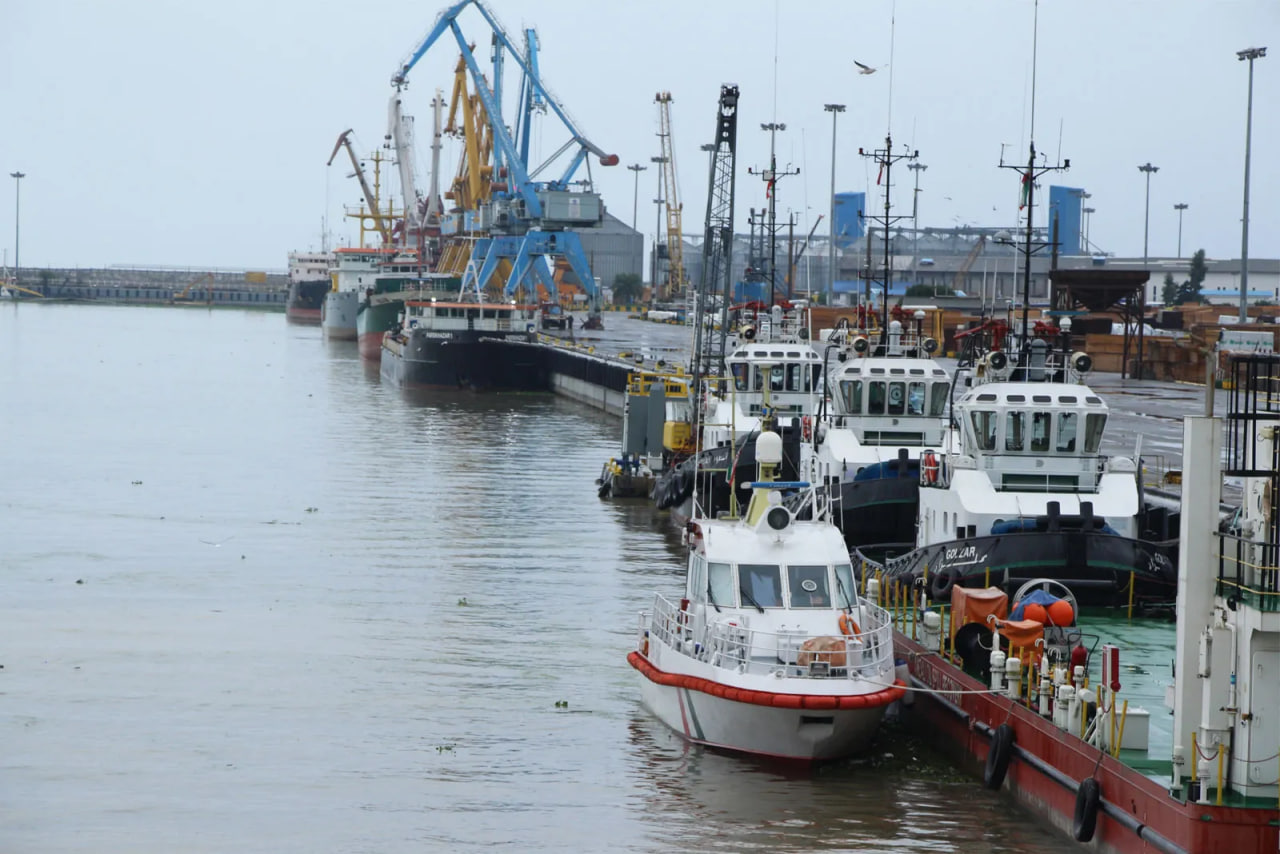
Rising regional tensions are pushing Iran to rethink the structure of its foreign trade network. The recent military conflict involving the United States and Israel against Iran, along with growing political friction between Tehran and the United Arab Emirates, has once again exposed Iran’s deep dependence on Dubai’s Jebel Ali port. For decades, the Emirati port has acted as Iran’s unofficial commercial gateway, handling re-exports, warehousing, banking services and cargo transit for Iranian businesses.
Although trade between Iran and the UAE has not stopped, Iranian traders say operations have become increasingly difficult. Cargo transfers, banking services, insurance coverage and cooperation with intermediary companies are now facing greater restrictions and political risks. These developments have renewed attention toward Iran’s northern ports and the Caspian Sea as possible alternatives for part of the country’s foreign trade.
Trade data for the first 10 months of the Iranian year 1404 (March 2025-March 2026) show the scale of Iran’s dependence on southern routes. About 65.7% of Iran’s foreign trade by weight, equal to 107.2 million tons, moved through the Persian Gulf, the Sea of Oman and Chabahar. The UAE accounted for nearly 20.3% of Iran’s imports and remained one of the country’s main re-export and logistics partners. Trade with China and the UAE still relies heavily on southern maritime routes connected to the Persian Gulf.
Increased Interest
At the same time, regional instability and security concerns in the Persian Gulf have increased interest in the Caspian Sea and northern transport routes. Iran’s growing trade with Russia, Kazakhstan, Azerbaijan and other Eurasian countries has also strengthened the importance of northern ports such as Anzali, Caspian, Amirabad and Astara.
Business groups believe current conditions could become an opportunity for Iran to redesign part of its trade geography. However, many experts stress that replacing Jebel Ali in the short term is unrealistic because the port is not simply a shipping hub but a massive logistics, financial and commercial network developed over decades.
Qasem Rezaeian, vice chairman of the Gilan Chamber of Commerce, told Donya-e-Eqtesad newspaper that “the Caspian coastline has now become a safe and important route for Iran” due to military tensions in the Persian Gulf and the declining efficiency of Jebel Ali for Iranian traders. He added that Gilan Province has become increasingly important because of Iran’s expanding trade with members of the Eurasian Economic Union.
According to Rezaeian, northern Iranian ports currently have an estimated annual capacity of 30 million tons. “Astara has road, rail and maritime connections simultaneously, while shipping companies are active at Caspian Port in the Anzali Free Zone,” he said. He explained that railway lines from different parts of the country already connect producers to northern free zones and ports.
Major Challenges
Despite these advantages, major challenges remain. One of the biggest problems is the incomplete transport infrastructure in northern Iran. The Rasht-Astara railway project is still unfinished, forcing much of the cargo movement onto roads, which increases both costs and transport time.
Shipping capacity in the Caspian Sea is another major issue. Iran faces shortages of container and roll-on/roll-off vessels, while falling water levels and shallow draft conditions in some ports have limited the ability of larger ships to dock.
Rezaeian acknowledged these weaknesses, saying that Iran currently suffers from “a shortage of vessels for expanding trade in the Caspian Sea.” He noted that around 100 ships are currently active in the basin, although capacity could increase two or even three times with proper investment. He also stressed the importance of completing the Rasht-Astara railway to strengthen Iran’s position in Eurasian trade.
Biggest Obstacle
Beyond infrastructure, analysts argue that management problems remain one of the country’s biggest trade obstacles. Ali Akbar Shabani, a customs logistics expert, said Iran’s main challenge is the lack of unified border management rather than physical infrastructure shortages.
“The main problem in Iran’s trade system is the absence of unified management at customs,” Shabani told Donya-e-Eqtesad. According to him, 23 separate organizations currently operate at Iranian border crossings, often with overlapping regulations and conflicting procedures.
Shabani argued that reducing institutional overlap could significantly improve trade efficiency. “If customs becomes the main authority for cargo entry and exit procedures, the possibility of replacing routes such as Jebel Ali would increase considerably,” he said.
Iran has recently introduced some limited reforms, including delegating part of the customs authority to provincial governors in order to reduce clearance times. However, private sector representatives say these changes remain insufficient and many unnecessary regulations still increase costs for traders.
Broader Reality
The debate surrounding the Caspian Sea ultimately reflects a broader economic reality for Iran. The country cannot quickly replace its southern trade routes or eliminate dependence on Jebel Ali overnight. Yet regional instability is increasing pressure on policymakers to diversify trade channels and reduce geopolitical vulnerability.
Expanding northern ports, completing railway projects, modernizing the Caspian fleet and simplifying customs procedures could gradually shift part of Iran’s trade toward Eurasian markets. Without such reforms, however, Iran’s foreign trade network will remain highly exposed to political tensions and security risks in the Persian Gulf.