
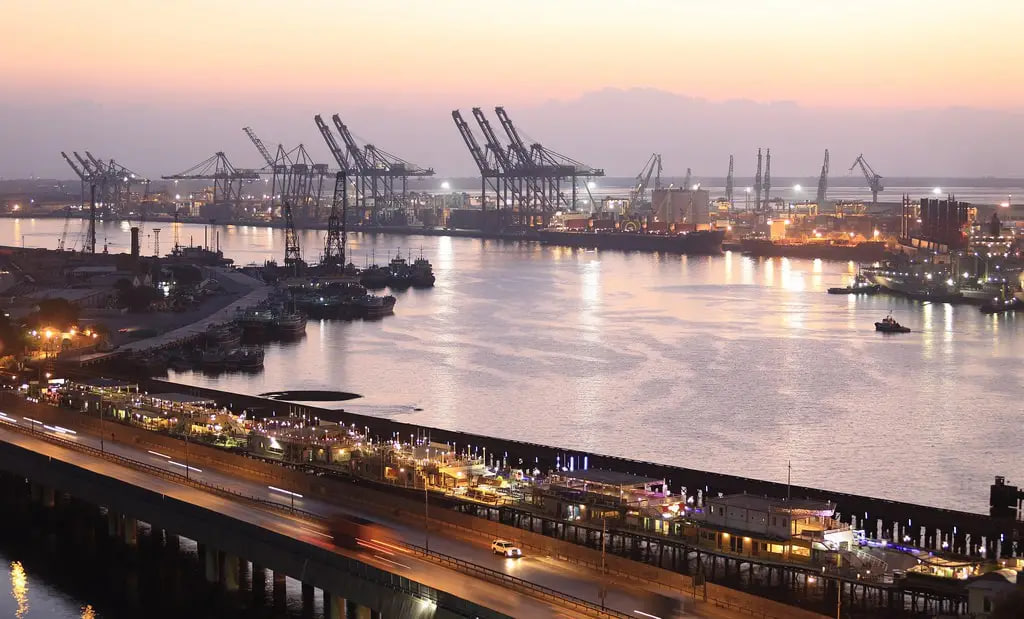
As pressure on Iran’s southern ports intensifies and maritime risks in the Strait of Hormuz rise, Pakistan is emerging as an important trade lifeline for the Iranian economy. The launch of six new land routes between the two neighbors has opened an alternative corridor for thousands of containers previously dependent on Persian Gulf shipping lanes. Yet a key question remains: can Karachi become a realistic alternative to Dubai’s Jebel Ali?
For now, the answer is limited. Pakistan may help Iran reduce pressure caused by restrictions on maritime trade, but the country still lacks the infrastructure, logistics capacity and customs efficiency needed to replace the Persian Gulf’s established trade hubs. Even so, the recent developments signal a major shift in Iran’s regional trade priorities.
Pakistani media recently reported that Islamabad had authorized the transfer of foreign-made goods to Iran through Pakistani territory. The decision came as tensions in the Persian Gulf disrupted shipping linked to Iranian ports and increased uncertainty around maritime transport. Reports suggested that more than 3,000 containers destined for Iran had become stranded at Karachi Port because of instability in Persian Gulf shipping lanes. Pakistani authorities responded by redirecting part of this cargo through overland routes into Iran.
The development reflects a broader reality facing Tehran. For decades, Iran relied heavily on maritime trade routes connected to southern ports and logistics hubs such as Jebel Ali Port. However, growing geopolitical tensions and rising risks surrounding sea transport have forced policymakers to look for alternative corridors. Pakistan, with its long border with Iran and access to the Indian subcontinent, has suddenly gained strategic importance.
Rising Trade
Trade data already points to growing economic ties between the two countries. According to Iran’s Trade Promotion Organization, bilateral trade reached around $3.1 billion in the Iranian year ending March 2026. Iranian exports accounted for about $2.4 billion, while imports from Pakistan stood at roughly $706 million. Pakistan is now Iran’s fifth-largest destination for non-oil exports after China, Iraq, the UAE and Turkey.
Despite this growth, trade relations remain far below their potential. During Iranian President Masoud Pezeshkian’s visit to Pakistan last year, officials from both countries discussed plans to raise bilateral trade to $10 billion. The current regional crisis may accelerate those ambitions.
Ali Emami, director general of logistics and support at Iran’s Trade Promotion Organization, said demand for trade through Pakistan has surged in recent weeks.
“The increase in demand has led to a significant rise in freight costs,” Emami told Donya-e-Eqtesad. “In some cases, transportation prices on this route have doubled compared to previous rates.”
According to Emami, Iranian authorities and trade representatives are trying to remove customs and logistics bottlenecks. He said daily truck traffic at the Mirjaveh border crossing currently stands at around 200 to 250 trucks but could rise to 800 trucks per day if infrastructure problems are resolved. He also pointed to improvements at the Rimdan border crossing, where customs procedures have been revised and roads are being expanded.
Still, Iranian officials acknowledge that Pakistan’s logistics system remains far behind the efficiency of Persian Gulf trade hubs.
“The UAE is an international logistics hub,” Emami said. “Cargo transfer there can be completed within hours. Karachi is neither a free zone nor a global logistics hub.”
Infrastructure Gaps
The comparison highlights the central challenge facing Pakistan’s growing role in Iran’s external trade. Karachi may provide a temporary solution during periods of crisis, but it cannot yet match the speed, scale and advanced infrastructure of Jebel Ali. The Pakistani route also comes with significantly higher costs, since land transport remains more expensive than maritime shipping.
Amir Roshanbakhsh Ghanbari, deputy head of international business development at Iran’s Trade Promotion Organization, described these rising costs as an unavoidable consequence of current geopolitical conditions.
“In the current conditions, when maritime restrictions have been imposed on the country, we are forced to use alternative routes even if transportation costs increase,” he said. “These are the costs imposed by war.”
At the same time, Ghanbari argued that Pakistan could become strategically valuable for Iran beyond the current crisis. He said the Pakistan-Iran transit corridor could strengthen Iran’s access to Central Asia and Eurasian markets while helping secure the flow of essential imports into the country.
The renewed focus on Pakistan also exposes how underdeveloped trade cooperation between the two countries has remained for decades. Despite sharing a long border and important geographic advantages, Iran and Pakistan failed to establish integrated customs systems and efficient transit infrastructure.
Morad Nemati Zargaran, Iran’s commercial attaché in Pakistan, previously argued that the economic potential between the two countries had long been ignored.
“Pakistan is a country of 250 million people with an import-oriented economy,” he said. “But for years, no strategic operational decision was made to expand trade relations between the two countries.”
For Iran, the Pakistani corridor currently represents an emergency economic bridge rather than a full replacement for Persian Gulf shipping routes. It offers Tehran an alternative path for trade at a time of rising maritime risks. However, transforming Karachi into a true alternative to Jebel Ali would require major investment in roads, railways, customs modernization and logistics infrastructure.