
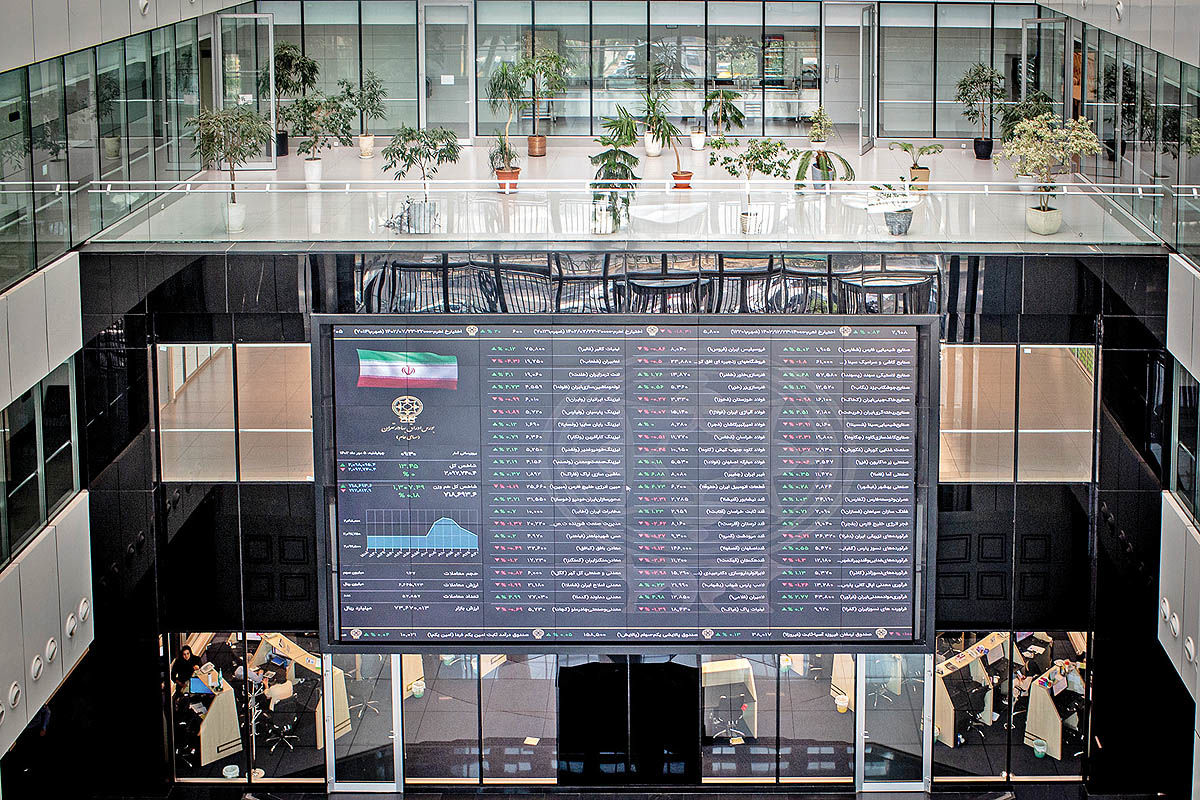
A statistical reading of retail capital flows since the start of the Iranian year (March 2025) reveals a decisive shift in portfolio preferences as political risk intensified.
In an environment marked by policy uncertainty and episodic geopolitical tension, investors have rotated away from equities toward lower-risk instruments—primarily fixed-income and gold funds.
The reallocation signals not merely defensive positioning but a broader transition toward risk management as the dominant organizing principle of retail investment behavior.
Data through the end of trading last week show fixed-income funds as the principal destination of retail liquidity, absorbing roughly 76,394 billion tomans ($477.5 million). Gold funds rank second, attracting more than 43,227 billion tomans ($270.2 million). By contrast, the equity market—including shares, options, and equity funds—recorded an outflow of about 52,695 billion tomans ($329.3 million).
The configuration indicates a pronounced reassessment of risk-return tradeoffs amid heightened macro and political ambiguity.
Fixed Income as Shock Absorber
Fixed-income funds drew strong interest early in the year, when predictable returns and lower volatility aligned with investor caution.
Prior to the onset of the 12‑day conflict between Iran and Israel (June 13–24, 2025), approximately 38 trillion tomans ($237.5 million) had flowed into these vehicles.
However, as tensions escalated and trading in fixed-income funds was suspended for one week, sentiment turned abruptly. Following the market’s reopening on Khordad 31 (June 21, 2025), roughly 26 trillion tomans ($162.5 million) exited within just three sessions, underscoring that even low-risk instruments are not immune to behavioral shocks during acute uncertainty. Net inflows from the beginning of the year consequently fell to about 12 trillion tomans ($75.0 million).
As political conditions partially stabilized, flows reversed once more. Through summer and autumn, and in tandem with continued caution in equities, inflows to fixed-income funds strengthened gradually.
Capital that had fled during the crisis largely returned, lifting cumulative net inflows to around 76,394 billion tomans ($477.5 million) by last week.
The pattern highlights the restoration of confidence in capital-preservation strategies and the role of fixed-income funds as the market’s stabilizing buffer.
Gold: A Barometer of Expectations
Gold funds traced a different path, closely tracking shifts in inflation and currency expectations. In the early months—amid optimism surrounding indirect Iran-US negotiations—expectations for currency depreciation softened, reducing the appeal of gold-linked assets. By Khordad 10 (May 31, 2025), more than 7 trillion tomans ($43.8 million) had exited gold funds.
From mid-Khordad (early June 2025), however, the direction flipped as geopolitical risk intensified and inflation expectations revived.
The post-conflict period amplified this momentum, with robust inflows through summer and early autumn. By Azar 15 (December 6, 2025), cumulative absorption exceeded 63 trillion tomans ($393.8 million), an exceptional figure for the year.
Yet a partial reversal followed: from mid-Azar (early December 2025) to last week, more than 23 trillion tomans ($143.8 million) withdrew. Even so, net inflows to gold funds since the start of the year remain above 40 trillion tomans (over $250 million).
Implications for Market Dynamics
In aggregate, roughly 120 trillion tomans (about $750 million) moved into fixed-income and gold funds against equity outflows exceeding 53 trillion tomans (over $331.3 million).
Two implications stand out. First, persistent equity outflows constrain the formation of durable bullish trends and limit the capacity of market indices to stage strong rallies. Second, the retention of capital within the capital market—albeit via indirect vehicles—signals behavioral maturation.
Unlike past episodes when uncertainty triggered wholesale exits, a significant share of funds now remains invested through managed products, supporting market depth and the institutionalization of indirect investment.
A sustained return of retail money to equities will hinge primarily on reduced political uncertainty and greater policy stability. Until the macro outlook clarifies, the revealed preference for lower-risk assets is likely to persist.
The year’s data point to a structural rebalancing of capital in Iran’s markets—one in which risk control, not return maximization, sets the tone.