
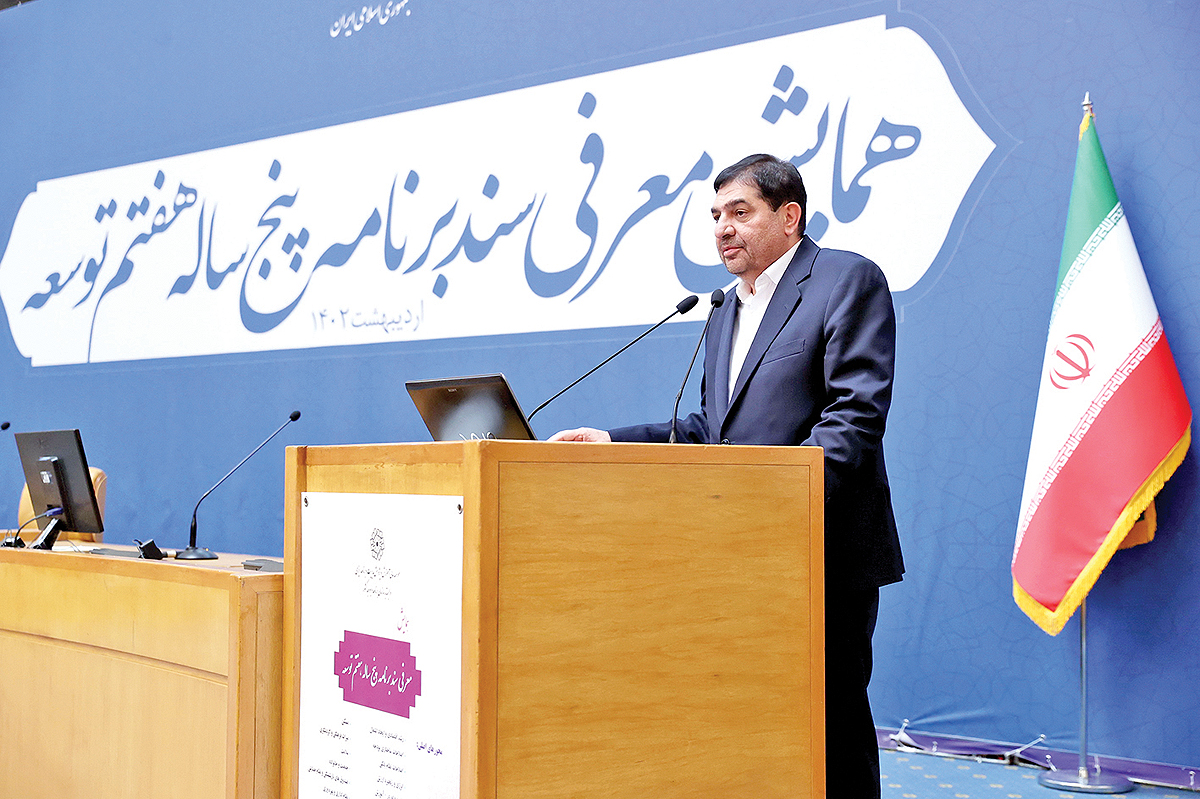
Iran’s Seventh Development Plan is already falling short of its ambitious industrial and mining growth targets, raising fresh doubts about the credibility of medium-term economic planning and the feasibility of state-led target setting.
The five-year plan, which began in March 2024 and runs through March 2029, sets annual growth targets of 8.5% for industry and 13% for mining. Yet official data from the Statistical Center of Iran indicate that performance during the first 18 months—nearly 30% of the plan’s timeline—has been far below these benchmarks.
Industrial growth stood at just 1.6% in the first year, while mining growth excluding oil was 1.3%. In the first half of the current Iranian year, industrial output contracted by 1.1%, with non-oil industry and mining shrinking by 0.9%.
At this pace, economists argue, closing the gap is mathematically implausible. Even assuming zero growth this year, industry and mining would need to expand by more than 15% annually in the remaining three years—an outcome widely seen as unattainable under current conditions.
Unrealistic Targets
“This problem is not unique to the Seventh Plan,” said Mazyar Nourbakhsh, a member of the Iran Chamber of Commerce. “We have seen the same pattern in previous development plans. Targets are often unrealistic and more symbolic than operational.”
He added that genuine private-sector input is largely absent during drafting, while execution mechanisms and incentives remain vague.
Nourbakhsh warned that instead of learning from repeated underperformance, policymakers continue to replicate past approaches. “If previous plans had truly been implemented, the economy would not be in its current state,” he said.
Others point to structural and policy constraints. Seyed Javad Hosseini-Kia, vice chairman of parliament’s Industries and Mines Commission, cited energy imbalances, foreign exchange shortages and declining household purchasing power as major drags on production.
“Development plans are written with aspirational goals so that even partial realization—say 50%—can be considered success,” he said, arguing that the Seventh Plan does not require revision.
That view is strongly contested by independent economists. Hossein Haqgoo, an economic analyst, described the plan’s industrial and mining objectives as “already defeated.” “With the exception of the Third Development Plan, Iran has consistently failed to achieve its macroeconomic growth targets,” he said. “When overall growth falls short, sectoral targets inevitably fail as well.”
Deeper Issue
Haqgoo argued that the deeper issue lies in the absence of a coherent industrial development strategy. Although official documents frequently describe industry as the engine of growth, macroeconomic, foreign exchange, trade and foreign policies are not aligned with that objective. “Industry has never truly been placed at the center of economic policymaking,” he said.
He also criticized the plan’s reliance on quantitative production targets—such as specifying steel or automobile output—calling them reminiscent of centralized, non-competitive planning.
“Many industrial firms are publicly listed and market-driven. Production decisions should be made by firms, not predetermined by the state,” he said.
The plan’s limited attention to technological change is another concern. As global industry moves toward automation, artificial intelligence and advanced manufacturing, Haqgoo noted that the Seventh Plan offers little support for innovation, competition or productivity-driven growth.
Without a strategic shift—particularly in foreign policy, investment attraction and technology transfer—analysts warn that Iran’s industrial sector risks further stagnation or contraction.
“Unless industry is genuinely treated as the core driver of economic development,” Haqgoo said, “incremental or cosmetic reforms will not reverse the current trajectory.”