
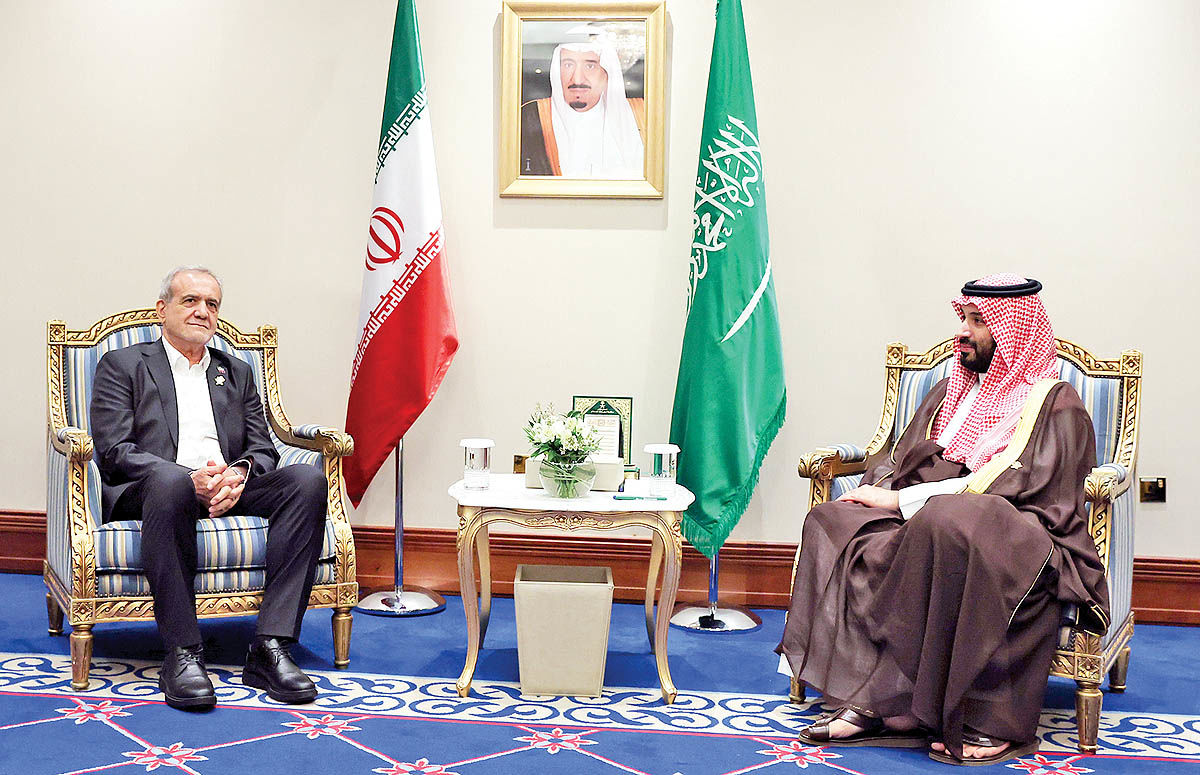
Despite the restoration of diplomatic ties and the reopening of embassies, economic relations between Iran and Saudi Arabia remain at one of their weakest historical points.
A review of trade data and expert assessments shows that political rapprochement has so far failed to translate into meaningful commercial recovery, highlighting a persistent disconnect between diplomacy and economics.
Historical trade figures underline the scale of the missed opportunity. During the early to mid-2000s (the first half of the Iranian calendar decade of the 1380s), bilateral trade experienced a relative boom.
Iran’s exports to Saudi Arabia reached about $236 million in 2004, rose to $256 million in 2005, and peaked at nearly $387 million in 2008. At the time, Saudi Arabia accounted for roughly 2% of Iran’s total exports, placing it among Iran’s top 20 export destinations.
Even after political frictions emerged, trade remained notable: Iranian exports stood at $107 million in 2011, rebounded to $160 million in 2014, and reached $134 million in 2015, shortly before the complete severance of relations.
Analysts argue that had the trade trajectory of 2005 continued uninterrupted—adjusted for inflation and market expansion—Iranian exports to Saudi Arabia could today approach $1 billion. This opportunity cost is magnified by Saudi Arabia’s rapid economic expansion and structural changes in consumption over the past decade, which have turned the kingdom into an increasingly attractive import market—one in which Iran has largely lost its foothold.
No Serious Will
Yet the revival of diplomatic ties has not ignited a similar recovery in trade. According to Hamid Hosseini, a member of the Iran–Iraq Joint Chamber of Commerce, there is still no clear Saudi commitment to direct economic engagement with Iran.
“There is no serious will on the Saudi side to start direct trade with Iran,” he told Donya-e Eqtesad. He noted that a joint chamber of commerce has not been established and that no concrete steps have been taken to facilitate bilateral trade. Some Iranian goods may reach Saudi Arabia via third countries such as the UAE, but direct commercial links remain absent.
“Even Iranian traders attending Saudi exhibitions often do so under the names of their UAE-based companies,” Hosseini said.
Structural factors further limit prospects. Saudi Arabia is largely self-sufficient in sectors such as petrochemicals and steel, reducing demand for Iranian exports. Current Iranian sales are mostly confined to traditional and high-value niche goods—such as carpets, saffron and caviar—often routed through intermediaries.
Meanwhile, although Iran has technical and engineering capabilities, Saudi Arabia’s reliance on major international firms leaves little room for Iranian companies.
Sanctions cast an even longer shadow. A political analyst cited by Donya-e Eqtesad stressed that sanctions continue to obstruct flights, visas for Iranian businesspeople and the docking of Iranian vessels.
“The pace of economic normalization does not match the speed of political reconciliation,” the analyst said, adding that unresolved logistical and regulatory barriers have raised the cost and risk of market entry for Iranian traders, including participation in trade fairs.
Core Problem
Ali-Akbar Asadi, an international relations expert, argued that the core problem lies in the non-complementary nature of the two economies.
“Both Iran and Saudi Arabia are energy exporters and importers of consumer goods and technology,” he said, noting that even in periods of better political relations, economic ties never became the main pillar of bilateral engagement.
Without sanctions relief, legal guarantees and high-level economic agreements, he warned, trade will remain limited, informal and dependent on intermediaries.
The Iran–Saudi case illustrates how political détente alone is insufficient to revive trade. Persistent sanctions, structural competition, logistical barriers and weak economic will have left commerce trailing far behind diplomacy—suggesting that without decisive policy shifts, the promise of renewed economic ties will remain largely unrealized.